%20(2).png?width=600&height=150&name=Clinicline%20Horizontal%20logo%20(600%20x%20150%20px)%20(2).png)
AI Answering Systems vs. Human Medical Teams: Finding the Perfect Fit for Your Canadian Clinic
By Dhruv Randeria on Aug 10, 2026, 2:07:17 PM

Quick Answer
Choosing between a voice-first artificial intelligence platform and a human administrative team for a Canadian clinic is no longer an all-or-nothing decision. While human medical office assistants (MOAs) offer irreplaceable clinical empathy and complex triage, conversational AI handles unlimited concurrent calls and eliminates busy tones 24/7. To maximize both clinical focus and your bottom line, the modern gold standard is a hybrid staffing model: keeping a lean in-person team for face-to-face patient engagement while using a secure, PHIPA-compliant AI answering system to automate phone queues and after-hours bookings.
The Core Deficit: Where Canadian Front Desks Lose Time and Margins
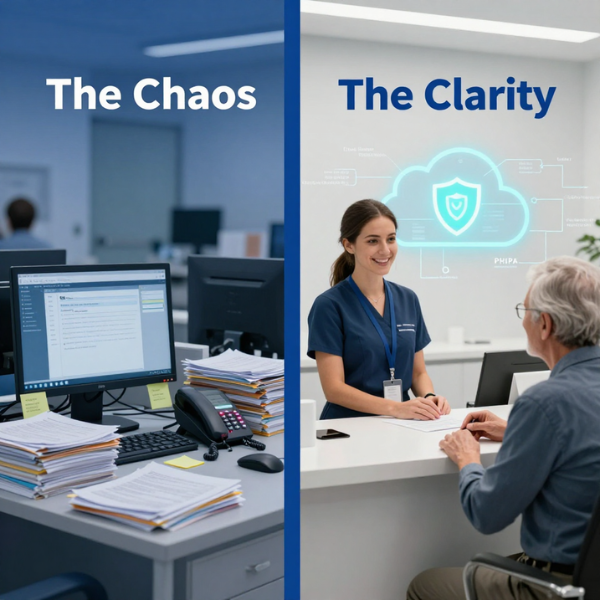
Running a clinic in Canada involves managing persistent administrative strain, strict privacy criteria, and unpredictable call volumes. When an on-site team is forced to split attention between a patient standing at the counter and a ringing telephone line, your clinic's operational flow breaks down.
Time and revenue quietly disappear into three prominent front-desk bottlenecks:
- The High-Volume Call Spike: Monday mornings, billing cycles, or seasonal flu waves generate sudden surges of inbound phone traffic that a physical receptionist cannot keep up with.
- The After-Hours Booking Leak: A massive segment of healthcare consumers browse or attempt to book treatments outside standard 9-to-5 parameters. Unanswered calls over lunch, during evenings, or on holidays mean lost patient bookings that simply move to a competing clinic.
- The Multitasking Overload: Forcing on-site staff to log intake sheets while simultaneously fielding continuous baseline phone questions results in booking friction and extended in-office wait times.
The Real Impact: The primary cost here extends past simple hourly payroll expense. It represents the cumulative financial liability of unbooked appointments and burned-out local teams who are constantly interrupted by a ringing phone bank.
Side-by-Side Operational Comparison
To understand how these workflows align with your daily needs, consider how live staff and automated AI voice receptionists match up across crucial clinical categories:
|
Operational Category |
Traditional Human Team |
AI Voice Medical Receptionist |
|
Simultaneous Line Capacity |
One call at a time per person. Excess traffic routes to long hold queues or voicemail.
|
Unlimited. Answers dozens of incoming patient calls concurrently with zero busy tones.
|
|
Availability & Hours |
Tied to fixed office shift windows; leaves gaps during lunch breaks and evenings.
|
24/7/365. Operates continuously through nights, weekends, and statutory holidays.
|
|
Clinical Nuance & Triage |
Excellent: Provides high empathy, reads patient hesitation, and handles complex emergencies.
|
Structured: Follows pre-defined clinic FAQ protocols, basic screening paths, and booking parameters.
|
|
Data Privacy & Compliance |
Requires ongoing manual file discipline and strictly monitored on-site user login habits.
|
Built-in Logging: Encrypted transmission streams and automated system user access logs.
|
|
Hiring & Operational Drag |
Rigid Fixed Overhead: Includes payroll, benefits, space, hardware, and onboarding costs.
|
Flexible SaaS Model: Scalable software utility tier pricing without statutory employer liabilities.
|
Evaluating the True Economic Footprint of In-House Intake
When calculating front-desk budgets, practice managers often look exclusively at raw hourly base wages. This calculation ignores the true total cost of employment (TCO), which significantly inflates the bottom line:
- Benefits, Payroll Taxes, & PTO: Employer-paid health coverage, statutory contributions (CPP/EI), and paid vacation routinely add 25% to 35% on top of base compensation.
- The Workspace Tail: Providing physical desks, corporate phone system hardware, software user licenses, and office utilities requires dedicated clinic space that could otherwise act as a revenue-generating examination room.
- Paid Downtime: Clinics must financially cover statutory breaks, sick days, personal time, and natural workplace socialization hours where direct administrative production stops.
A Realistic Financial Comparison
When looking at an annual timeline, a standard full-time in-house administrative receptionist carries an all-in total cost of ownership of ~$61,800+ per year.
By contrast, integrating a dedicated cloud system costs a small fraction of a human salary, creating a 90%+ drop in initial call-capture overhead for managing routine, repetitive informational questions and standard appointment bookings.
📊 Want to analyze your practice's specific numbers? Staffing expenses, panel dimensions, and call drops vary significantly from province to province. Use the interactive ClinicLine Savings Calculator to see exactly how much annual overhead you can cut by offloading your administrative bottlenecks.
Why Generic Automated Attendants Fail Canadian Healthcare Clinics
Search the market and you will find hundreds of low-cost general AI answering apps and interactive voice response (IVR) systems. However, using a generic bot in a Canadian healthcare setting creates serious operational and legal risks:
- The Privacy Trap (PHIPA & PIPEDA Compliance): Generic retail platforms frequently route and store voice data on unencrypted international servers. In Canada, patient information must comply with strict provincial regulations like Ontario’s PHIPA or Alberta’s HIA. Healthcare-grade software builds end-to-end encryption and compliance guardrails right into the core architecture.
- No Canadian EMR Interactivity: Generic corporate tools operate in an isolated vacuum. They cannot natively interact with primary Canadian practice scheduling systems (like Jane App and OSCAR) to verify real-time grid availability, resulting in booking conflicts or manual entry backlogs for your staff.
- Frustrating Phone Trees: Patients avoid rigid "Press 1 for hours, Press 2 for directions" menus. Modern conversational tools rely on polite, natural linguistic processing to carry out fluid, back-and-forth phone conversations, answering clinic-specific questions instantly.
The Workflow Multiplier: How AI Empowers Human Staff
Transitioning routine phone inquiries to an automated voice receptionist doesn't mean replacing your human team—it elevates them. When you delegate repetitive tasks to a conversational system, you unlock distinct operational advantages:
- Elimination of Front-Desk Burnout: By absorbing thousands of repetitive questions ("Where are you located?" "Do you do direct billing?"), AI reduces the cognitive overload that strains front-office teams.
- Elevated In-Office Culture: Your receptionists can finally step away from a constantly ringing phone bank. They can dedicate their unfragmented attention to greeting the patient sitting in the lobby, managing complex care plans, and facilitating smooth room turnarounds.
- Optimized Revenue Generation: Because the AI answers multiple lines instantly 24/7, your clinic catches every potential new patient inquiry, weekend adjustment booking, and appointment confirmation automatically.
Designing a Modern, Connected Tech Architecture
To fully bridge the gap between software capability and clinical reality, progressive practices look at their tools as an interconnected ecosystem. Rather than relying on standalone software programs that require your local team to manually maintain them, you can leverage a cohesive product stack designed for Canadian healthcare.
Through the ClinicLine Product Suite, practices can seamlessly embed specialized AI utilities directly into their existing cloud infrastructure:
- Automated Voice Intake: Deploying a custom ClinicLine AI Voice Receptionist guarantees that patients receive immediate, polite assistance on the first ring, syncing appointment slots straight into your core EMR day or night.
- Hands-Free Document Routing: Practices can clear the daily bottleneck of inbound faxes, diagnostic charts, and laboratory reports by integrating ClinicLine AI Fax Triage. The system reads incoming documents, categorizes records, and securely routes data files directly into the correct patient charts with absolute compliance.
Frequently Asked Questions
Q: Will Canadian patients feel frustrated speaking with an automated voice assistant?
A: In most cases, no. Modern medical-grade systems utilize natural, flowing conversational models tailored to sound polite, clinical, and reassuring. Because the interaction functions like a standard back-and-forth telephone call rather than a rigid, button-pressing digital phone tree, patients receive immediate answers to basic scheduling and operational questions without waiting on hold.
Q: Can a virtual or automated receptionist handle advanced billing and prior authorizations?
A: AI voice tools excel at immediate call capture, basic schedule updates, and answering clinic FAQs. However, for deep administrative workflows—such as correcting provincial billing rejections, tracking complex multi-layered specialist referrals, or chasing private insurance adjusters—clinics achieve the best results by pairing software with a dedicated, remote virtual Medical Office Assistant (MOA).
Q: How do secure automated tools maintain compliance with provincial health privacy acts?
A: Compliance requires strict data sovereignty and verified access controls. Dedicated healthcare tools ensure that all data processing complies with provincial frameworks like PHIPA. Every scheduling modification, patient note transmission, or document file routing is isolated within secure networks and logged under unique system permission criteria, ensuring your patient data remains fully protected.
Embracing the Hybrid Model
Optimizing a modern Canadian clinical workspace is no longer about choosing between a fully automated system or an expensive human team. True practice growth relies on the intentional pairing of both assets.
By deploying conversational AI as your first line of telephone availability—capturing high-volume queues, basic queries, and midnight booking requests instantly—you protect your margins. This frees up your human receptionists to deliver the deep empathy, relationship building, and hands-on office coordination that no piece of software can replicate.
To learn how to streamline your front desk, eliminate dropped calls, and lower your clinic's administrative overhead, explore our advanced options and Get in Touch with ClinicLine today.
About Us
These Related Stories
9 Admin Tech Tools That Save Canadian Clinics Time (And How to Maximize Them)

A Day in the Life of a Canadian Medical Office Assistant And How Virtual Workflows Eliminate Burnout

No Comments Yet
Let us know what you think